Utility
Shipped Prototype
Synapse: AI that keeps your ideas organized, alive, and in motion
Synapse is a thought capture and organization tool which catches half formed ideas, routes them into the right project or topic automatically using lightweight inference, and surfaces a synthesis when a cluster reaches critical mass, which closes the intention to action gap that traditional PKM tools leave wide open. Built with Figma, Next.js, React, d3 force, and Claude Code as a co designer.
Your mind is mostly filled with other people's thoughts, views & ideas. What happens to your original thoughts and ideas?
Designed and built a capture tool that routes every thought to a project or topic on its own, shows you why it went there, and turns each cluster into one next step you can act on today.
Made healthcare accessible for elders and care workers. Shipped on iOS and Android. Booking went from a multi-step flow to four taps, and every core screen clears WCAG AA for older eyes.
The Problem
Most of your brain is someone else's thinking.
Open any of these tools and count what is actually inside. Saved articles. Clipped threads. Screenshots of other people's posts. Highlights from books you did not write. The tool is working exactly as designed. What it holds is other people's thinking. Your own ideas get the worst treatment in the same system. A saved article files itself, it arrives with a source and a topic already attached. A half formed thought arrives mid walk with no title and no obvious folder, so it waits for you to invent a category for it, and you do not.
The ideas that lose to filing friction are the ones nobody else has.
That is why capture had to be free. The friction is not evenly distributed. It falls hardest on the thoughts that only you have.
Where this comes from
Sweller found working memory holds about four items at once. Choosing a folder competes for the same four slots the thought is sitting in. So the capture bar has no folder picker, no tag prompt, and no mode you have to pick before you start typing.
The unglamorous half of the worker's day
Guide records vitals for a whole queue, books visits for patients who can't, and hands a patient to a colleague with their full history. It also runs the worker's own day: shifts, leave, expenses and escalations.


The Decision
Proof over convenience: a one time code at the door
A one time code from the patient's phone proves both sides agreed the visit began, so the family knows it happened and the worker can prove they were there.
The catch: ten awkward seconds at the door, and it needs the phone nearby. Worth it for proof both sides can trust.
Also on the board
Beyond the two apps, we explored a third surface: a tool for staff and partners to manage records on Praana's behalf. It stayed an exploration, but it sharpened how we thought about who else touches this data.
Tried & Failed
Explorations: what we tried and set aside
Not everything made it in. We tried different home screen layouts, a blood and plasma donation match, and several pricing structures before settling the ones that shipped.

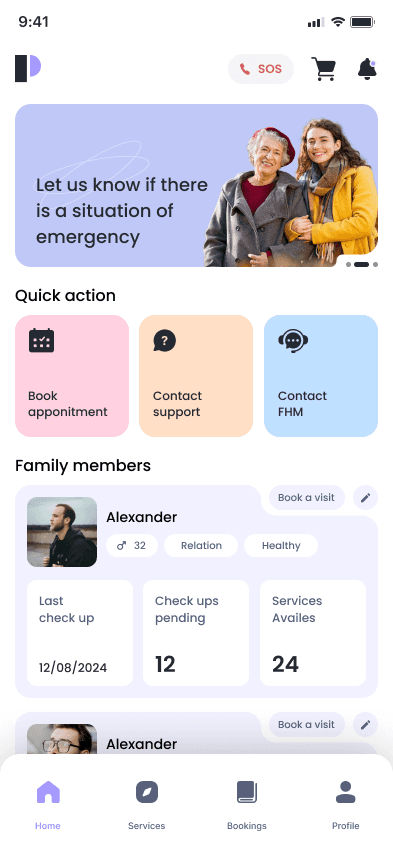


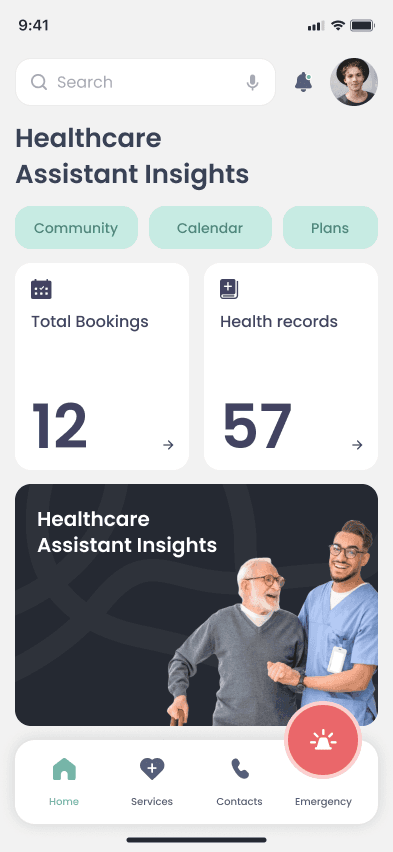

Color and Theme


Layout and Information Architecture